



 Best Seller
1998–2006 Audi TT Mk1 Service and Repair Manual PDF
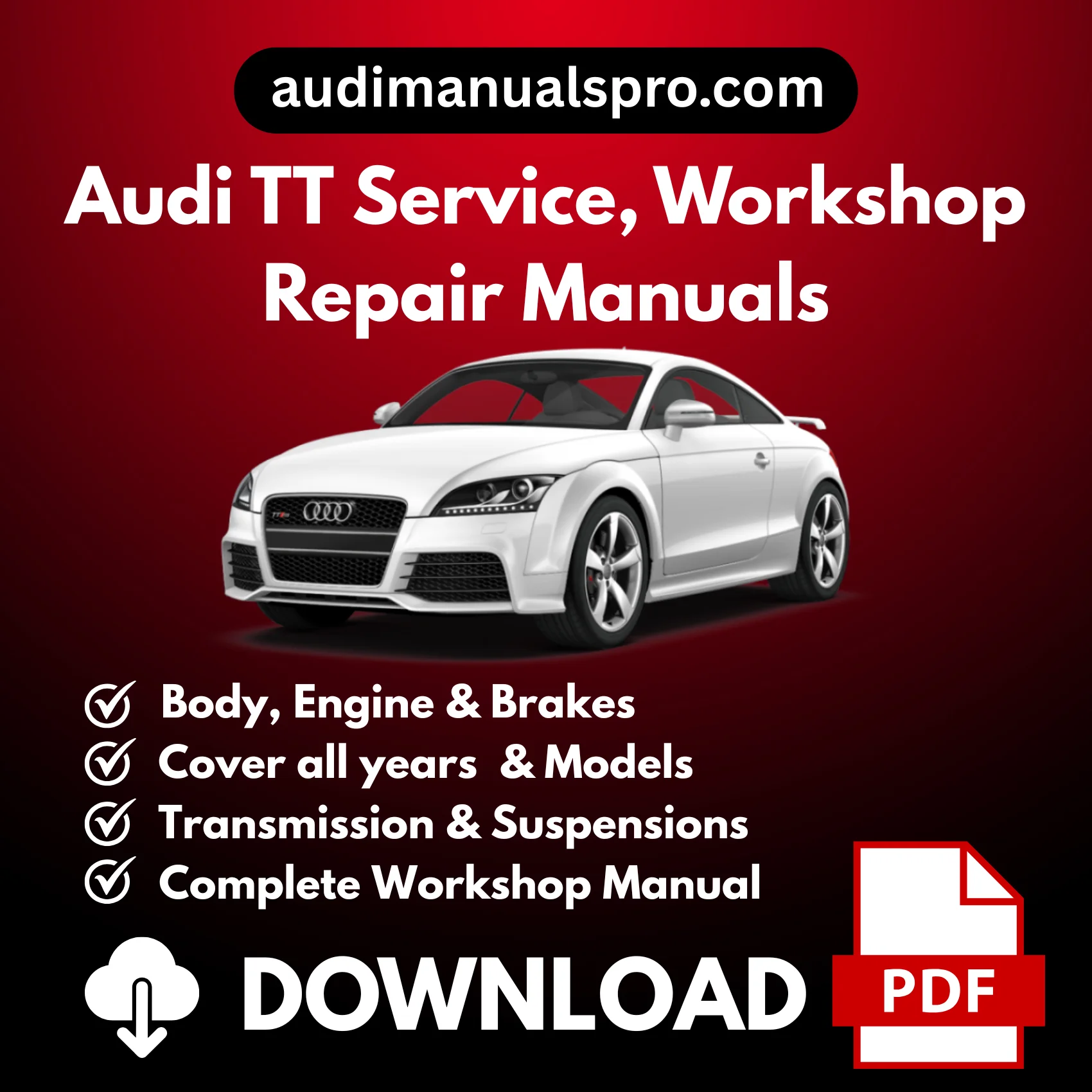
Workshop manual set for the Audi TT Mk1 (Typ 8N, 1998–2006), Coupé and Roadster, front-wheel drive and quattro, pre- and post-recall cars. Covers the 1.8T coil pack failure, the notorious dashpod instrument cluster fault, the Haldex service most owners never had done, and the DSG on the 3.2 VR6. Download link sent within 24 hours of payment.
 You will get Download Link within 24 hours
 Secure Payment, Easy Download, 24/7 Support


Description
Audi TT Mk1 (Typ 8N) Service and Repair Manual — 1998 to 2006
The first-generation TT is a design icon with a complicated past. Early cars were the subject of a high-profile safety recall after a series of high-speed accidents — Audi retrofitted a rear spoiler, revised the ESP and altered the suspension. If you own an 8N, knowing whether your car is a pre- or post-recall example changes what you are looking at underneath, and it is one of the first things this documentation helps you establish.
Beyond that, the TT is a raised-floor A3/Golf underneath its beautiful body, which means its mechanical faults are well understood — the coil packs, the dashpod, the Haldex service, the DSG. All known, all fixable, all covered here.
What the TT Mk1 is
Built from 1998 to 2006 on the PQ34 platform — shared with the Mk4 Golf and the 8L A3 — the first TT was sold as a Coupé (8N3) and a Roadster (8N9), with front-wheel drive or quattro. The quattro cars use a Haldex clutch-pack all-wheel-drive system, not a mechanical Torsen, and that Haldex needs a fluid and filter service that a great many owners never knew existed.
The famous safety update in 1999–2000 brought the rear spoiler, revised ESP calibration and suspension changes to the early cars. Later cars had these from the factory.
Engines covered
| Engine | Engine codes | Output | Notes |
|---|---|---|---|
| 1.8T 20v turbo | AJQ, ARY, AUM, ARZ, AUQ | 150–190 PS | Coil packs — see faults |
| 1.8T 20v turbo (225) | BAM, APX | 225 PS | Twin intercoolers, K04 turbo |
| 1.8T 20v turbo (240) | BFV | 240 PS | quattro Sport, late run |
| 3.2 VR6 quattro | BHE | 250 PS | DSG available |
The 1.8T is the volume engine, and the higher-output 225 and 240 versions differ meaningfully — twin intercoolers, a bigger K04 turbo and different plumbing. The 3.2 VR6 is a different animal again, and the only engine offered with the DSG. The documentation keeps them separate rather than blurring them into one “1.8T”.
Transmissions
Five- and six-speed manual — clutch, dual-mass flywheel, release bearing, linkage and fluid specification.
DQ250 six-speed DSG (dual clutch) — fitted to the 3.2 VR6 and a landmark gearbox as one of the first dual-clutch units in a road car. Mechatronic diagnosis, clutch pack condition, the oil and filter service interval that is non-negotiable, and the basic settings procedure.
Haldex all-wheel drive (quattro) — the clutch-pack coupling with its pump and filter. Fluid and filter service, pre-charge pump diagnosis, and controller fault tracing. Neglected Haldex fluid is the usual reason a quattro TT stops driving the rear wheels — and it is a service most owners have never had done.
The dashpod — a signature TT failure
The instrument cluster on the TT, universally called the “dashpod,” is a known and specific weak point. The gauges — most often the fuel and temperature — behave erratically or die, and it can also throw the car into a no-communication state that mimics far more serious faults.
The failure, its symptoms, the removal procedure and the repair route are documented. Recognising a dashpod fault for what it is saves owners from chasing sensors and wiring that are perfectly healthy.
Electrical and diagnostics
Full wiring diagrams for Coupé and Roadster, connector views and pinouts, the central convenience module, the Roadster’s electric hood circuit, the dashpod, immobiliser and key adaptation, ESP and ABS module identification, and fault code tables.
The TT diagnoses over K-line on early cars and CAN on later ones. The correct interface and procedure for each are covered.
Known TT Mk1 faults you will be looking up
- Coil pack failure (1.8T) — sudden misfire, limp mode, flashing engine light. The single most common TT fault. Coil identification and the revised part.
- Dashpod / instrument cluster failure — erratic or dead gauges, and communication faults that mimic worse problems.
- Haldex fluid and filter neglect (quattro) — no rear drive, or intermittent engagement. A service most owners have never had done.
- 1.8T oil sludge — the turbo oil feed cokes up on stretched intervals or the wrong oil, destroying the turbo. Prevention and inspection.
- N75 and diverter valve — boost leaks, overboost and low power. Test both properly.
- Cam follower and timing on the 1.8T — timing belt interval, tensioner and water pump; interference engine.
- 3.2 VR6 DSG mechatronic — juddering or gear refusal on the dual-clutch cars.
- Roadster hood mechanism and hydraulics — a roof that stops halfway, or leaks. Motor, hydraulics and the drainage that protects the electrics.
- Rear spoiler motor (post-recall cars) — the deployable spoiler mechanism and its faults.
- Control arm and suspension bushes — the PQ34 front-end wear shared with the A3 and Golf.
- Window regulator failure — the cable snaps and the glass drops.
- Central locking pump — running constantly or failing to lock.
What’s inside this manual set
- Engine — removal, overhaul, timing, torque specifications
- Fuel, ignition and forced induction systems
- Cooling and lubrication
- Transmission — manual, DSG and final drive
- Clutch, driveshafts and the Haldex all-wheel-drive system
- Brakes, including ABS and ESP
- Suspension and steering, with alignment data
- Body — panel repair, body dimensions, the Roadster hood, trim removal
- Heating, ventilation and air conditioning
- Electrical — full wiring diagrams, connector views, the dashpod
- Diagnostics — fault codes, measuring blocks, adaptation
- Maintenance schedules and service reset procedures
Format and delivery
Supplied as a set of searchable PDF files covering the TT Mk1 across the full 8N run — Coupé (8N3) and Roadster (8N9), front-wheel drive and quattro, pre- and post-recall cars. Readable and printable on any device: laptop, tablet, phone, or the workshop PC. No software to install, and no internet connection needed once the files are saved.
Select your year at checkout. After payment, your download link is sent within 24 hours.
Frequently asked questions
My TT is misfiring with a flashing engine light. Is that the coil packs?
Almost certainly. Coil pack failure is the single most common 1.8T fault, on the TT as on every other car that uses the engine. The documentation covers identification and the revised part before you spend money on plugs or a loom.
My gauges are behaving strangely or have died. Is that the dashpod?
Very likely. The TT’s instrument cluster is a known weak point, and it can cause erratic gauges and even communication faults that look far more serious than they are. Removal and the repair route are covered.
Does the quattro TT need a Haldex service?
Yes — and most have never had one. The Haldex clutch-pack system has a fluid and filter that need servicing, and neglect is the usual reason a quattro TT stops driving the rear wheels. The service and the pump diagnosis are documented.
Is the 3.2 VR6 with DSG covered?
Yes, including the DSG mechatronic diagnosis, clutch pack and the oil and filter service that the dual-clutch box genuinely needs.
What is the difference between a pre- and post-recall car?
Early cars were recalled after high-speed stability concerns and received a rear spoiler, revised ESP and suspension changes. Later cars had these from the factory. The documentation helps you establish which you have, because it affects what you are working on.
Does it cover the Roadster hood?
Yes — the mechanism, the hydraulics and the drainage that keeps water away from the electrics. A hood stuck halfway is a documented diagnostic sequence.
Will this work with VCDS?
Yes. Fault codes, measuring blocks and adaptation channels map to VCDS. Early cars use K-line and later cars CAN, so make sure your interface supports the right one.
Related products


Reviews
There are no reviews yet.